A buyer who falls for a wooded acre in Frontenac Forest usually pictures the same build timeline they'd get on a cleared lot anywhere else in St. Louis County: buy the land, demo or clear, break ground, done in under a year. Then they file a tree removal application, or find out their subdivision has trustees who review projects before the city ever sees the plans, and the timeline they budgeted for stretches by months they didn't plan for.
That gap between what a Frontenac lot appears to offer and what it actually lets you do with it is the story most listings don't tell you. The mature canopy that makes these one-acre-plus parcels feel private and established isn't simply included with the deed. Large stretches of it are protected by city ordinance, and the process for touching it runs through more than one approval body, in a specific order, on a schedule that only meets twice a month.
The median price depends on which nine homes sold
Before getting to the trees, it's worth sitting with how thin the Frontenac sales data actually is, because it explains why the "market value" on a portal can look completely different depending on which month you check.
In March 2026, one national portal reported Frontenac's median sale price at $1.7 million, up 89.4% year over year, with price per square foot up 35.1%. Four months later, in July 2026, a different tracking source put the median sold price at $1 million, on just 9 closed transactions, compared with 14 sales in the same month the year before, with the average home spending 41 days on the market versus 9 days the prior year. A third source pegged the median list price in June 2026 at $895,000, down roughly 8% year over year on a per-square-foot basis.
None of these numbers are wrong. They're measuring a market where fewer than a dozen homes typically close in any given month, on lots that range from a Cape Cod update on a half-acre to a new-construction estate on a flat one-acre parcel near Frontenac Mall. When the sample size is that small, a single high-end estate sale or a single wooded teardown lot can move the reported median by hundreds of thousands of dollars in either direction. That's the first thing to understand before you anchor an offer, or a listing price, to whatever figure a portal is showing this week: in Frontenac, the median isn't describing a market trend. It's describing whoever happened to close that month.
Which is exactly why the more useful question for a specific wooded lot isn't "what's the median," but "what can actually be built here, and how long will it take to get permission."
What the trees actually protect
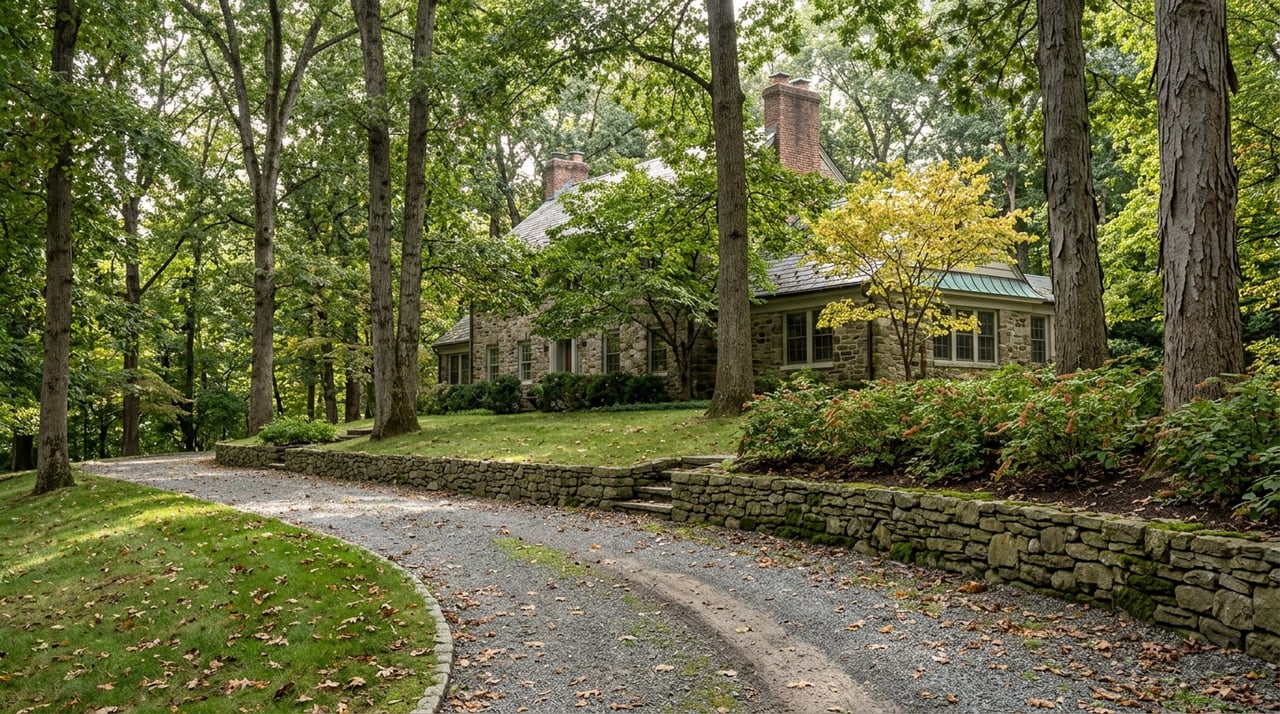
Frontenac's rolling, wooded character isn't accidental. The city grew out of horse country: the Otis Brown Stables on Countryside Lane and the Palmer Stables and Clayton Hunt Club on Bridle Lane once anchored a network of riding trails that ran from Geyer Road toward what's now the Plaza Frontenac property, and many subdivision names near Geyer Road still carry that equestrian and English countryside influence. The tree canopy on today's estate lots, in subdivisions like Twin Fawns or Ballantrae, is a direct descendant of that rural terrain, and the city has written rules to keep it that way.
Under the city's tree preservation code, you cannot remove a healthy "grand tree," any tree with a trunk three inches or more in caliper inside a designated wooded area, or 25% or more of the trees on a lot, without first securing a permit. Diseased or hazardous trees are exempt, but only if an ISA-certified arborist has made that determination. Any contractor doing the actual removal has to be licensed through the city, not just licensed to do tree work generally. And for new construction or any project disturbing more than an acre, the city requires a full tree preservation plan, prepared with a licensed landscape architect, mapping every tree on the property and justifying which ones come down.
For a buyer eyeing one of the wooded, sloped lots that Frontenac listings often describe as a "builder's dream," this isn't a formality. It's the difference between a lot that can absorb the footprint you're picturing and one where the mature trees you loved on the walkthrough are the reason your architect has to redraw the plan.
Two approvals, and the order matters
Removing trees is only the first layer. Building anything new, or expanding an existing structure's exterior, requires sign-off from the city's Architectural Review Board, and the ARB has a rule that catches people off guard: if the property sits in a subdivision governed by its own trustees, the ARB will not vote on the project until those trustees have reviewed it first. The city board also won't consider a project without full construction plans in hand, so there's no submitting a concept sketch to get informal feedback before you've paid an architect for finished drawings.
The ARB meets only on the first and third Thursday of each month, at 8:30 a.m. That cadence means a project that misses a cutoff, or gets sent back for revisions, doesn't just lose a few days. It loses two to four weeks waiting for the next meeting, on top of whatever time the subdivision trustees needed beforehand. Builders who work in Frontenac regularly, including Frontenac Homes, run by brothers Tim and Pat Dolan, and Aleto Construction Group, which has been renovating St. Louis County homes since 1955, build this sequencing into their schedules as a matter of course. Buyers coming from a market without trustee-governed subdivisions or a twice-monthly board often don't, and it shows up as unplanned holding costs on a lot that hasn't broken ground yet.
The acre line that brings in the state
There's a third layer that applies specifically to Frontenac's larger lots. Missouri requires a Department of Natural Resources land disturbance permit for any site where an acre or more of land will be disturbed, and that threshold applies even to a smaller phase of a project if the overall development will ultimately disturb an acre or more. Given how many Frontenac lots are marketed specifically as flat or gently sloped one-acre-plus parcels, this state permit comes into play more often here than it would in a neighborhood built on smaller, subdivided lots. It runs alongside, not instead of, the city's own ordinary and major land disturbance permitting, which is filed separately depending on the scope of grading involved.
Stack it up: tree removal permit, tree preservation plan for anything over an acre or involving new construction, trustee review where applicable, Architectural Review Board approval on a twice-monthly calendar, and a possible state land disturbance permit once excavation crosses the acre threshold. None of these steps are unusual on their own. The sequence, and the fact that most of it has to happen before a shovel touches the ground, is what turns a "six-month build" assumption into something closer to nine or twelve.
What this means depending on which side of the closing table you're on
If you're the buyer looking at a wooded Frontenac lot for new construction or a substantial rebuild, the useful move before you write an offer is finding out whether the property sits in a trustee-governed subdivision, and asking your architect or builder to walk the tree line with you before you finalize a house plan. A grand tree standing where you'd planned a garage wing is a problem better discovered during due diligence than during framing.
If you're the one selling a long-held Frontenac property with mature trees, the same information works in your favor when it's presented honestly. A lot that's already been surveyed for its buildable envelope, with any grand trees identified up front, gives a serious buyer confidence that the acreage they're paying for is the acreage they'll actually get to use. Sellers who let a buyer discover the ordinance on their own, mid-contract, tend to lose leverage they didn't need to give up.
A few questions worth asking directly
Does the tree ordinance apply if I'm renovating instead of building new? The full landscape and tree preservation plan requirement is triggered by new construction or any project disturbing more than an acre. But the underlying permit requirement for removing a grand tree, a mature tree in a wooded area, or 25% of the trees on a lot applies regardless of whether the work is a renovation or a ground-up build.
What actually counts as a "grand tree" in Frontenac? The city's code defines it by species and size rather than sentiment. Confirming a tree's status before you plan around or against it is worth the arborist's fee.
Can I take down a dead or hazardous tree without going through this process? Yes, but only when an ISA-certified arborist has documented that the tree is diseased or poses an immediate hazard. Removal for convenience or view doesn't qualify for that exemption.
A wooded Frontenac lot is still one of the more distinctive pieces of real estate in St. Louis County's Central Corridor, and for the right buyer, the canopy and privacy are exactly the point. The trees just come with a process attached, and knowing that process before you're under contract is worth more than any median price a portal can hand you this month. If you're weighing a lot like this, or preparing one to sell, The Ryan Tradition has spent decades working through exactly this kind of Central Corridor detail with clients on both sides of the table. Contact us before you write the offer, not after the tree crew shows up.
This article is general information, not legal, tax or financial advice. Consult a qualified professional about your situation.