Pull up three listing sites for Town & Country in the same afternoon and you will find three different housing markets. One shows a median sale price near $2.5 million. Another shows an automated valuation estimate around $1.18 million. A third shows a median list price under $900,000. None of these numbers is wrong. Each one is describing a different slice of a city that looks, from the outside, like a single housing market. It is not. Town & Country has been quietly stratifying into at least three distinct housing products for years, and the newest of them, a McBride Homes community called Manor Hill, makes the divide easier to see than it has ever been.
Four Numbers, One City
In January 2026, Redfin reported a median sale price of $2.5 million in Town & Country, a figure the site itself flagged as up 237.9 percent year over year. That swing is not a market trend. It is six closed sales for the month, up from five the prior January. A six-home sample in a low-volume luxury market will produce whatever number the six sellers happened to agree to, and that particular month happened to include some large, well-appointed properties.
Zillow's estimate for the same city, as of August 2026, sits closer to $1.18 million, up 6 percent over the past year. That figure is not a sale price at all. It is an automated valuation model averaged across every home Zillow tracks in the city, occupied and unoccupied, listed and off-market alike. It measures something real, but it measures a different thing than a closing statement does.
Movoto's June 2026 figure put the listed median at $873,000, down from the prior spring. That number reflects what sellers are asking right now, which tends to run lower than what buyers ultimately pay in a market where homes move quickly, and it also reflects whatever mix of product happens to be actively listed that month, which is not necessarily representative of the city's full inventory.
A full trailing twelve months of closed MLS sales through June 2026 tells a steadier story: 104 closed transactions at a median of $1.45 million, essentially unchanged from the prior twelve-month period, with homes spending a median of five days on the market against an active inventory of just 34 listings. That is the number worth anchoring to if you are trying to understand the city as a whole. But even a steady twelve-month median hides the fact that it is blending three or four fundamentally different kinds of houses into one figure.
Several Kinds of House
Town & Country incorporated in 1950 as a wholly residential city, but it has never had a single kind of housing stock. Its housing stock includes at least three kinds.
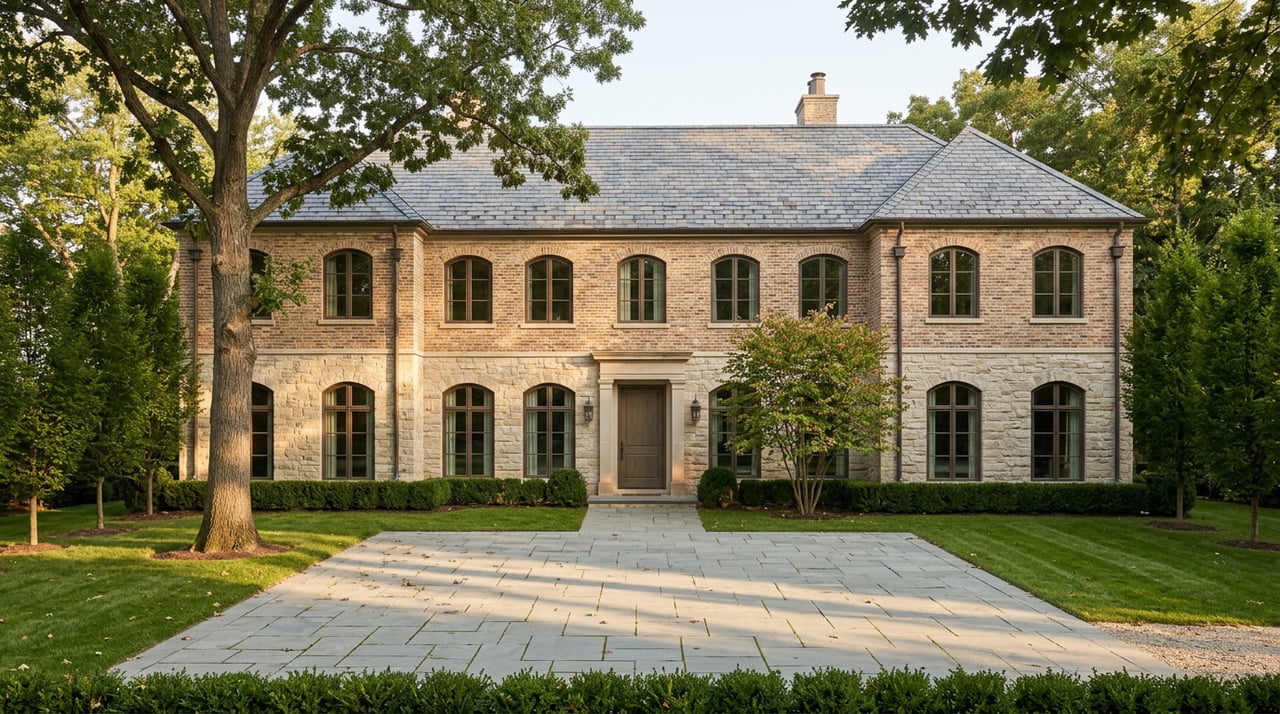
The original estate corridor runs along Mason Road, where some of the city's oldest parcels sit under the Estate "E" zoning classification and run 80,000 square feet or larger, nearly double the one-acre minimum. These are the properties with mature tree canopy, long private drives, and architecture that predates most of the surrounding subdivisions. They rarely turn over, and when they do, the price reflects land and legacy as much as square footage.
Closer to Bellerive Country Club, which hosted the 1965 U.S. Open, the housing stock tilts newer but not new. Multi-acre sites here carry a mix of 1980s and 2000s construction, and a growing share of that inventory is being purchased specifically to be torn down and rebuilt rather than renovated. This is the corridor where a buyer is often paying for the lot and the location, not the structure standing on it.
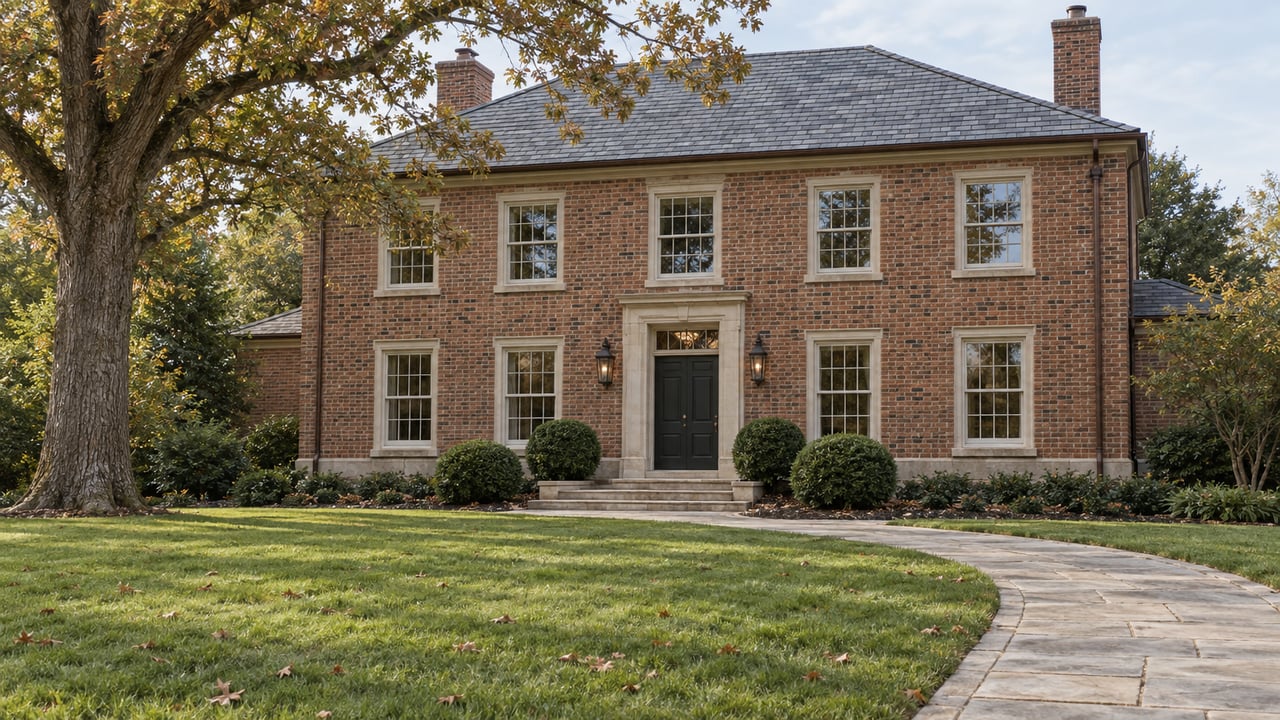
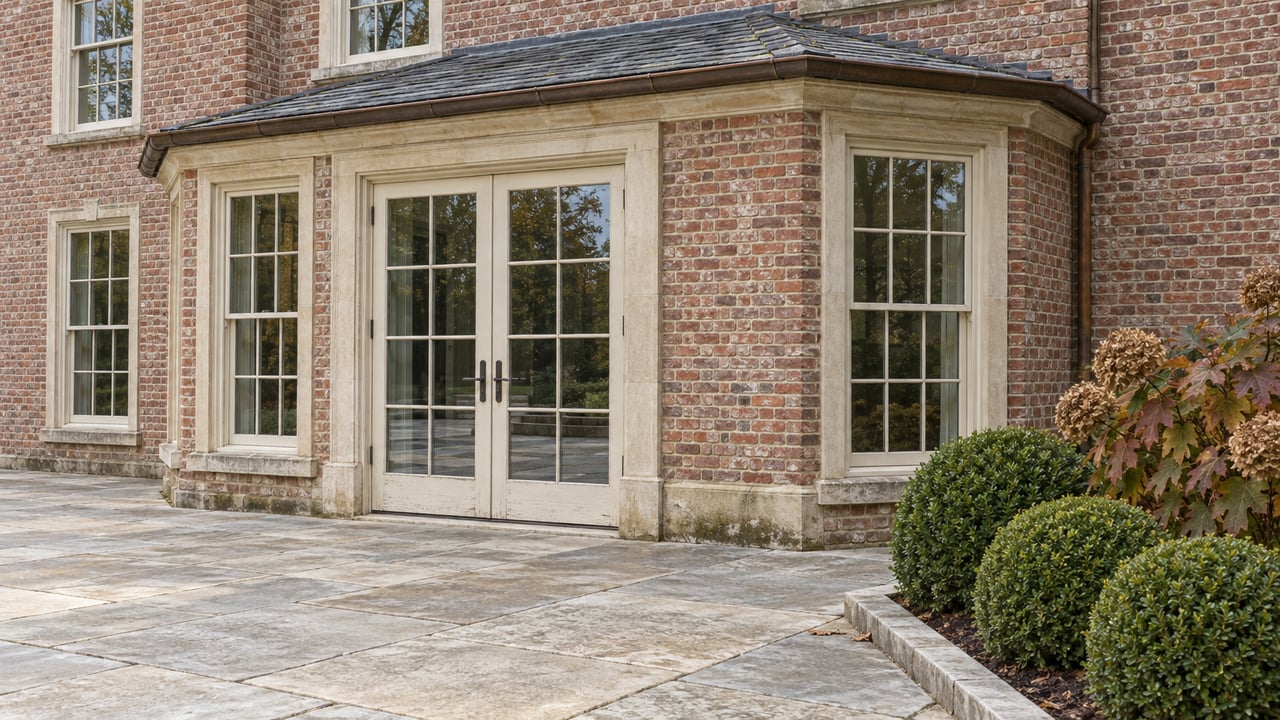
Then there is Manor Hill, the newest entrant and the clearest evidence that Town & Country's housing stock is not one thing. McBride Homes, Missouri's largest homebuilder, is offering ground-up construction on 1.3-acre homesites there, smaller than the historic Mason Road parcels. The models carry names rather than numbers. The Scottsdale, a French Country-inspired design, runs just over 5,674 square feet and has listed as a to-be-built home at $3,049,000. The Nottingham II, a single-level custom ranch, has listed at $3,015,000. Larger designs go further still: the Hawthorne offers just over 6,375 square feet, and the Westchester IV, a modern farmhouse estate, runs over 7,121 square feet.
Do the arithmetic on the Scottsdale and the per-square-foot cost lands around $537. Compare that to Redfin's citywide figure of $325 per square foot from that same six-sale January sample, and the gap tells you something concrete: new construction at Manor Hill is not competing on the same price-per-square-foot basis as the rest of the city's blended average. It is a separate product tier, priced accordingly, and any citywide median that does not separate it out will understate what new construction actually costs and overstate what a buyer should expect to pay for an older estate home nearby.
A Fourth Wrinkle: The Condo Product
Town & Country has long been described as having no apartment buildings and no multi-family housing within its limits, a description that held for most of its history. That is starting to shift. McBride Homes has a condominium floorplan under construction near the Highway 141 and Interstate 64 corridor, a two- and three-bedroom design slated for completion in spring 2027. It is a small development relative to the city's single-family stock, but it matters for one reason: any list-price median that includes even a handful of smaller, lower-priced condo units alongside multimillion-dollar estate listings will pull the blended number down in a way that has nothing to do with estate-home values softening. This is likely part of why Movoto's June 2026 list median reads so far below the trailing twelve-month sold median. Different inventory, same zip code, one confusing number.
The lesson is not that any of these figures is inaccurate. It is that a single median cannot describe a city built from four structurally different products under one zoning floor.
Reading a Listing Against the Right Comparable
For a buyer comparing Town & Country to Ladue, Frontenac, or Clayton, the practical takeaway is to identify which of these sub-markets a given listing actually belongs to before comparing its price to anything else. A Mason Road estate lot should be measured against other legacy parcels with mature landscaping and long ownership histories, not against a Manor Hill new build. A teardown-candidate near Bellerive should be evaluated on land value and rebuild potential, not on the condition of the existing structure. A to-be-built home at Manor Hill should be compared to other new construction, where the premium for a builder's design studio and finish selections is priced in from the start.
The citywide statistic that carries the most weight is the trailing twelve-month closed figure, because it smooths out the month-to-month noise that makes Redfin's six-sale readings and Movoto's shifting list prices unreliable on their own. But even that steadier number is an average of unlike things. A serious buyer asks which lot type, which build era, and which zoning classification a listing sits in before deciding whether its asking price looks high, low, or right in line with its actual peer group.
A Few Questions Worth Asking Directly
Is new construction at Manor Hill a better value than an established estate home? It depends on what the buyer is optimizing for. New construction offers modern systems, but it starts at a smaller lot size than the historic Mason Road corridor and carries a per-square-foot premium that older inventory does not.
Does a one-acre lot guarantee estate character? No. Some one-acre parcels hold 1980s construction awaiting a teardown decision, and some hold homes with fifty years of landscaping and architectural pedigree behind them.
Why do portal estimates disagree so much for the same address? Because they are frequently measuring different things: closed sales versus active listings versus automated valuations, over different time windows and different sample sizes. The gap tends to be widest in low-volume markets like this one, where a handful of sales can swing a monthly figure dramatically.
If you are comparing Town & Country to another Central Corridor neighborhood, or trying to determine which of these sub-markets fits your search, John Ryan has spent decades reading St. Louis's most exclusive neighborhoods block by block rather than by headline number. Contact us to talk through what a specific listing's price actually reflects before you make an offer on it.
This article is general information, not legal, tax or financial advice. Consult a qualified professional about your situation.